
Pasadena Domestic Violence Defense Lawyers
If you've been accused of domestic violence in Pasadena, you're facing one of California's most aggressively prosecuted and serious categories of criminal offenses.

Local law enforcement agencies in Pasadena play a significant role in enforcing California's strict domestic violence laws. Their particular intensity in pursuing these charges is a key aspect of the local legal context.
California's approach to domestic violence reflects a zero-tolerance policy that prioritizes victim protection above all else.
This means that once law enforcement responds to a domestic violence call, the legal machinery moves swiftly and often without regard to the alleged victim's wishes to drop charges.
When law enforcement is called to the scene of a domestic dispute, they are typically investigating whether a party was physically harmed or threatened unlawfully.
Emergency Protection Order
If the officers deem an accusation credible and if any physical "traumatic condition" is apparent, they will often make a felony arrest. The bail set for this type of arrest is typically $50,000.
Police officers will typically encourage the alleged victim to request an "Emergency Protective Order" (EPO) that will prevent the arrested person from having any contact with them.
This stark reality underscores the critical need to engage the services of a skilled Pasadena criminal defense attorney to protect your rights if you've been accused of domestic violence.
Enforcement for Domestic Violence Crimes in Pasadena
Domestic violence enforcement in Pasadena operates through a coordinated system involving multiple agencies.
Local law enforcement, including the Pasadena Police Department and Los Angeles County Sheriff's Department, respond to domestic violence calls throughout neighborhoods from Old Pasadena to the Rose Bowl area.
However, these cases are prosecuted in California state courts under the jurisdiction of the Los Angeles County District Attorney's Office.
Required Arrests for Domestic Violence Calls
California Penal Code Section 13701 mandates that law enforcement officers make an arrest when they have probable cause to believe domestic violence has occurred.
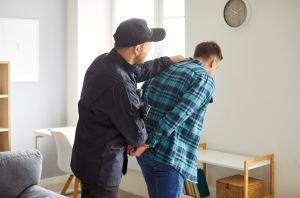
This mandatory arrest requirement removes officer discretion in most situations. Suppose officers respond to a domestic violence call and observe evidence of physical injury, signs of a struggle, or credible witness statements.
In that case, they must make an arrest regardless of the alleged victim's preferences. This strict enforcement approach means that many individuals find themselves in custody before fully understanding the severity of the allegations against them.
It's not even uncommon for police to arrest the wrong person if the evidence points them in a misleading direction.
Once an arrest has been made, the case moves to the Los Angeles County District Attorney's Office, which has established specialized domestic violence units. These prosecutors are trained specifically in domestic violence law and often pursue charges even when alleged victims request that charges be dropped.
Police Departments in Los Angeles County
- Los Angeles Police Department
- Los Angeles County Sheriff's Dept
- Long Beach Police Department
- Glendale Police Department
- Pasadena Police Department
- South Pasadena Police Dept.
- Beverly Hills Police Department
- Burbank Police Department
- Culver City Police Department
- San Marino Police Department
- Torrance Police Department
Common Domestic Violence Crimes in Pasadena
California law encompasses various criminal offenses under the domestic violence umbrella. The most frequently charged crimes in Pasadena include:
- Domestic Battery (Penal Code Section 243(e)(1)) involves unlawful touching of an intimate partner in a harmful or offensive manner. Unlike corporal injury charges, domestic battery does not require visible injury. This misdemeanor offense can result in up to one year in county jail.
- Corporal Injury to a Spouse or Cohabitant (Penal Code Section 273.5) applies when someone willfully inflicts physical injury resulting in a traumatic condition on an intimate partner. This felony carries potential sentences ranging from probation to four years in state prison.
- Criminal Threats (Penal Code Section 422) occurs when someone threatens to commit a crime that would result in death or great bodily injury to an intimate partner. The threat must be specific, immediate, and cause reasonable fear. This wobbler offense can be charged as either a misdemeanor or a felony.
- Stalking (Penal Code Section 646.9) involves following, harassing, or threatening someone to the extent that the person fears for their safety. In domestic relationships, stalking charges often arise from unwanted contact after separation.
- Violation of a Restraining Order (Penal Code Section 273.6) occurs when defendants contact or approach protected persons in violation of court orders. Even seemingly innocent contact can result in additional criminal charges.
Other Common Domestic Violence Charges
- Penal Code 236 PC - False Imprisonment
- Penal Code 273d - Child Abuse
- Penal Code 273a - Child Endangerment
- Penal Code 270 PC - Child Neglect
- Penal Code 368 PC - Elder Abuse
- Penal Code 653.2 PC - Cyberstalking
- Penal Code 647(j)(4) - Revenge Porn
- Penal Code 601 PC - Aggravated Trespassing
- Penal Code 136.1 PC - Intimidating a Witness
- Penal Code 591 PC - Damaging a Phone Line
By hiring Eisner Gorin LLP immediately after an arrest, we can help advise you on the many legal issues that arise after a domestic violence arrest. Additionally, it is crucial to promptly identify witnesses and gather evidence to be used in court for your defense.
At the first court date, called the arraignment, the judge will decide how much bail will be imposed and whether the amount will remain the same, be reduced, or, in some cases, be increased.
Domestic Violence Restraining Orders
Accusations of domestic violence often lead to the issuance of a restraining order. This process typically involves three stages, each of which underscores the importance of seeking legal advice.
- Emergency Protective Orders (EPO), issued by law enforcement on the spot, last up to seven days and require the accused to stay away and surrender firearms.
- Temporary Restraining Orders (TRO), issued by a judge shortly following the alleged incident, protect for up to 25 days pending a hearing, and may address child custody, spousal support, and shared residences.
- Permanent Restraining Orders are issued after a court hearing. They typically last up to five years but can be renewed indefinitely.
Notably, the EPO can even prevent the arrestee from going home for up to 5 days if they reside with the victim.

If children reside in the home, Child Protective Services (CPS) is often called to investigate if the children are in danger of harm.
As noted above, police will encourage the victim to pursue a restraining order. Depending on the circumstances, they may even encourage that a permanent restraining order be obtained.
Restraining orders have serious consequences. They can force you from your home, require you to change your routines, affect employment, and may impact child custody.
Violating a restraining order is a criminal offense, leading to additional charges and penalties.
Mitigation Package
After our law firm is retained, we can begin the process of coordinating the documentation for a "mitigation packet," if appropriate for your case.

A mitigation packet is typically a collection of documents and evidence compiled by a criminal defense attorney to present the defendant as a person to prosecutors and judges rather than just a legal case number.
With this information, in the appropriate cases, we present it to the prosecutor or judge to seek an office conference, pre-plea diversion, reduced charges, or a dismissal.
Its purpose is to persuade them to be more lenient, leading to reduced charges, probation, a lighter sentence, or alternative programs like diversion. The packet normally includes the following:
- Resumes
- Character letters
- Proof of employment
- Proof of home ownership
- Proof identifying children you support
- Community involvement
- Letters of recommendation
- Records of personal growth
- A personal statement from the defendant explaining their remorse and commitment to rehabilitation.
If the matter cannot be resolved in this manner, then we prepare to litigate and fight for our clients through a jury trial.
Defending Against Domestic Violence Charges in Pasadena
If you're facing domestic violence charges in Pasadena, hiring an experienced criminal defense attorney is your best hope of avoiding the worst outcomes and protecting your rights. Common defense approaches for domestic violence include:
- Lack of Intent Arguments contend that any injury or contact was accidental rather than willful. Many domestic violence statutes require proof of specific intent to harm.
- Self-Defense Claims argue that any physical contact occurred while defending oneself from attack. California law permits the use of reasonable force to protect against the immediate danger of bodily injury.
- False Accusation Defenses challenge the credibility of allegations, often highlighting motives for fabrication such as child custody disputes, divorce proceedings, or revenge for relationship conflicts.
- Constitutional Violations examines whether law enforcement violated Fourth Amendment rights during arrests or searches, potentially leading to evidence suppression.
Contact Eisner Gorin LLP for a confidential consultation and a clear plan to protect your freedom and future.
By appointment, the law firm may meet the client at 1055 E Colorado Blvd., 5th Floor, Pasadena, CA 91106 for case preparation, strategy, and review.
 If you have one phone call from jail, call us! If you are facing criminal charges,