
A great deal of public attention has been given to recent protests in Los Angeles opposing Immigration and Customs Enforcement (ICE) activities over the past several weeks.
While peaceful demonstration is a constitutional right under the First Amendment, it's crucial to remember that local authorities have the authority to invoke emergency powers when public safety is at risk, ensuring the safety and well-being of all residents.
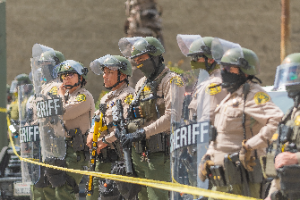
Under Los Angeles County Code (LACC) 2.68, authorities are empowered to implement emergency measures to address threats to life or property, including the imposition of emergency curfew orders.
These measures are often used when protests escalate into violence, property damage, or looting. Local authorities often also use curfews as a method of crowd control, such as when a protest lasts more than a couple of days.
Simply put, violating Los Angeles County curfew orders, specifically LACC 2.68.320, can result in a misdemeanor offense. This violation can result in a fine not exceeding $1,000 and/or imprisonment for up to six months.
The curfew was in effect from 8:00 PM to 6:00 AM in Downtown Los Angeles, requiring individuals to remain off public streets and other public areas during these hours. Following successful crime prevention and suppression efforts, Mayor Karen Bass has decided to lift the curfew for Downtown Los Angeles. As of Tuesday, June 17, 2025, the curfew is no longer in effect within Downtown Los Angeles.
What the Law Says
Under LACC 2.68.320, any violation of a curfew or other emergency order issued by local authorities constitutes a misdemeanor. Local officials have broad discretion to enforce curfews during times of crisis, such as riots or civil unrest.
These curfews aim to protect public safety and prevent the potential for chaos resulting from violent or destructive behavior. By law, curfew orders must be clearly communicated to the public. Individuals are generally notified through official announcements, press releases, or mobile alerts.
When a curfew is declared, everyone must disperse and return home by the curfew time or face possible criminal charges. However, the statute allows for three exemptions. Specifically, you may claim exemption from the curfew order if:
- You are homeless and have nowhere to shelter;
- You are on your way to or from work or school; or
- You are seeking medical attention.
Elements of the Crime
If you're charged with violating a curfew order in Los Angeles, rest assured that prosecutors must prove the following elements in order to convict you, ensuring a fair and transparent legal process:
- A Lawful Curfew Order Was in Effect: The curfew must have been established in accordance with state and local emergency protocols, and it must not be arbitrary or discriminatory in application.
- You Were Under the Jurisdiction of the Curfew: The curfew must apply to the location where the accused person was present during the hours it was in effect.
- You Knowingly Violated the Curfew: Prosecutors must demonstrate that you were aware of the curfew and intentionally failed to comply. If you can argue that you were unaware of the curfew or misinformed, this could impact the case.
Penalties for Violating Emergency Curfew Orders
Violating an emergency curfew order is a misdemeanor offense. If you're convicted, you could face:
- Fines Up to $1,000; and/or
- Imprisonment for up to six months
Juvenile Curfew Laws
When children, particularly teenagers, gather in large groups, it often attracts the attention of law enforcement. This is one of the reasons behind curfew laws and ordinances that restrict juveniles from being in public places at certain hours, as they aim to prevent potential issues and ensure the safety of young people.
Curfew laws typically restrict people younger than 16, 17, or 18 from remaining or loitering outside at night, or between specified hours, with the primary goal of ensuring their safety and well-being.

For example, a curfew may restrict juveniles from remaining outdoors between 11:00 p.m. and 5:00 a.m. Monday through Thursday, and between midnight and 6:00 a.m. on Friday, Saturday, Sunday, or on legal holidays.
Curfew laws are not blanket prohibitions against juveniles remaining in an area during specified hours. These laws allow for exceptions, such as when a parent or guardian accompanies the teen. Curfew laws and ordinances prohibit underage people from staying, remaining, or loitering in an area. This is different than simply being present somewhere.
For example, there is no curfew violation if a group of juveniles passes through a public area after curfew. However, if some of those juveniles decide to stay behind to loiter, they may violate curfew laws.
Curfew laws typically involve light penalties, and a juvenile violating curfew may not be punished at all in some situations. However, repeated curfew violations, or violations of emergency or business curfews, may be subject to harsher penalties. Additionally, parents or guardians of a juvenile who violates curfew may face penalties in certain situations.
Possible Defenses Against Curfew Violation Charges
If you are charged with violating a curfew order, there are several legal defenses a California criminal defense attorney may use to challenge the allegation. Common defenses include:
- Unlawful Curfew Order: An attorney may argue that the curfew order itself was unlawful. For instance, if the curfew violated constitutional protections or was not properly enacted under emergency protocols, the charges against you could be dismissed. Your attorney can file a motion to challenge the lawfulness of the curfew order, and a judge will review the motion to determine if the order was indeed lawful.
- You Qualified for an Exemption: If your attorney can show that at the time of the alleged curfew violation, you were traveling to or from work or school, experiencing homelessness without access to shelter, or seeking medical treatment, the charges against you may be dropped.
- Lack of Awareness or Notice: If there is evidence that the curfew was not clearly communicated to the public or that you were unaware of its implementation, your attorney could challenge the prosecution's ability to prove you knowingly violated an order. Your attorney can present evidence, such as a lack of public announcements or confusion about the curfew's start time, to argue that you were not aware of the curfew.
- Mistaken Identity: In protest situations, enforcement can be chaotic, causing some to be inordinately arrested and charged for being in the wrong place at the wrong time. Your attorney may explore whether law enforcement or witnesses incorrectly identified you as a violator of the curfew order. Your attorney can present evidence, such as alibis or witness statements, to argue that you were not the person who violated the curfew.
If you've been charged with violating a curfew order under LACC 2.68.320, understand that you still have legal rights and options. While curfews are an important tool for maintaining public safety during emergencies, they are not immune to legal challenges.
Local authorities must adhere to constitutional protections when instituting these orders, and individuals facing accusations have the right to defend themselves in court.
By working with an experienced defense attorney, you can explore the facts of your case, identify potential defenses, and build a strategy to protect your rights. For more information, contact our criminal defense law firm, Eisner Gorin LLP, located in Los Angeles.
Related Content:

 If you have one phone call from jail, call us! If you are facing criminal charges,