
The State of California imposes potentially stiff penalties for acts of petty theft (PC 488), grand theft (PC 487), or second-degree burglary (PC 459). If you're accused of committing one or more of these crimes during a declared state of emergency in California, you could be charged with looting under Penal Code 463 PC.

California law defines the crime of looting as a serious offense, taking advantage of a state of emergency to commit burglary, grand theft, or petty theft. Looting can be charged as a misdemeanor or a felony and is punishable by up to 3 years in jail, underscoring the severity of the crime.
A state of emergency can be declared by either the Governor of the State of California or a local governing body. States of emergency are typically declared as a result of a riot, flood, severe earthquakes, wildfires, storms, or other severe weather.
Looting is not just theft or burglary. It's a more severe offense that carries higher penalties upon conviction. If found guilty, you could face up to three years in prison.
Even if you're granted probation, you may still have to serve a brief mandatory sentence in county jail.
What Does PC 463 Say?
PC 463 directly addresses crimes of theft or burglary committed during a declared emergency due to natural disasters or manmade events. The law was enacted to deter individuals from taking advantage of chaotic and vulnerable situations during such crises, emphasizing the importance of preventing looting.
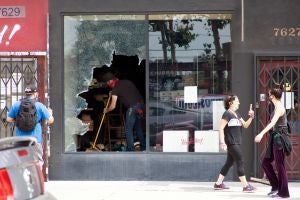
As noted, under this statute, acts of burglary, grand theft, and petty theft committed during these conditions constitute looting.
Because looting exploits communities in distress, California law imposes harsher penalties on individuals convicted under Penal Code 463 compared to those for first or second-degree burglary alone.
PC 463 says, "(a) Every person who violates Section 459, punishable as a second-degree burglary pursuant to subdivision (b) of Section 461, during and within an affected county in a "state of emergency" or a "local emergency," or under an "evacuation order," resulting from an earthquake, fire, flood, riot, or other natural or manmade disaster shall be guilty of the crime of looting, punishable by imprisonment in a county jail for one year or pursuant to subdivision (h) of Section 1170…."
Key Situations Covered Under Penal Code 463 PC
A "state of emergency" or "local emergency" means conditions which, by reason of their magnitude, are beyond the control of the services, personnel, equipment, and facilities of any single county or city, and require the combined forces of several regions.
The statute comes into play during specific emergency scenarios, including:
- A state of emergency, declared when a disaster exceeds the resources of local governments, such as during earthquakes, floods, or wildfires.
- A local emergency, declared by a city or county for localized disasters requiring immediate action.
- An evacuation order issued to protect residents from danger, such as civil unrest or structural dangers.
Key Takeaways
- Looting by burglary. One way to commit the crime of looting is to commit a second-degree burglary during a state of emergency or local emergency. The definition of a second-degree burglary is entering any structure that is not an inhabited dwelling, such as a store, with the intent to commit either a theft or any felony once inside.
- Looting by grand theft. You can be found guilty of Penal Code 463 PC looting if you commit the crime of grand theft during a state of emergency or local emergency. The definition of grand theft is stealing property with a value of more than $950.
- Looting by petty theft. You also commit the crime of PC 463 looting if you commit a petty theft during a state of emergency or local emergency. A petty theft is stealing property with a value of less than $950.
Elements of the Crime
To convict you of looting under Penal Code 463 PC, the prosecution must establish the following elements beyond a reasonable doubt:
- You committed an intentional act of burglary, petty theft, or grand theft. Since PC 463 hinges on the commission of one of these crimes, prosecutors must first prove that your actions met the criteria of one of these offenses (including proving that you acted with intent). This may include unauthorized entry into a property with the intent to steal or commit a felony, entering residential or commercial buildings, or stealing items from vulnerable areas.
- A declared emergency or evacuation order was in effect. An emergency declaration must have been in effect at the time the alleged burglary or theft was committed.
- You knew of the emergency condition. You must have reasonably known that a state or local emergency or evacuation order was in effect at the time of the alleged offense.
It's important to note that even damage to a building caused by a disaster does not excuse unlawful entry or theft. The law is designed to ensure that communities can recover without additional harm caused by criminal activities.
What are the Related Crimes?
Some common California crimes that are often charged along with Penal Code 463 PC looting include the following:
- Penal Code 404 PC participating in a riot. Rioting is defined as acting together with one or more other people to use force or violence, or credibly threaten to use force or violence, to disturb the public peace.
- Penal Code 594 PC vandalism. This law prohibits defacing, damaging, or destroying someone else's property. The penalties for California vandalism depend on the value of the property that is damaged.
- Penal Code 603 PC trespassing. This law prohibits entering another person's property without permission to do so. In most cases, trespass is a misdemeanor.
- Penal Code 409.5 unauthorized entry into a closed area; sightseeing during an emergency. This law makes it a crime to enter an area that has been closed by law enforcement because of a disaster such as a flood, earthquake, accident, explosion, etc. You are only guilty of this crime if you enter the area willfully and knowingly and remain there even after you have been asked to leave.
Penalties for Looting in California
Looting is a "wobbler" offense, meaning it can be charged either as a misdemeanor or a felony. The offense is punished based on the type of underlying offense and the state of the declared emergency. Here is how penalties are categorized:
- Looting by Second-Degree Burglary or Grand Theft: You may face up to one year in county jail (for a misdemeanor), or imprisonment up to three years (for a felony charge). Courts may also impose probation requiring at least 180 days in county jail. If the theft involves a firearm, the offense carries even more severe penalties.
- Looting by Petty Theft: Petty theft looting is charged as a misdemeanor and is punishable by up to six months in jail. The court has discretion to impose probation, usually including at least 90 days in jail.
In all such cases, community service hours are often mandated in addition to incarceration, particularly in programs focused on rebuilding the community.
Common Defenses to Looting Charges
If you're facing charges of looting, you are not without options. A skilled California criminal defense attorney may use one or more of the following strategies to fight the charges:
- Lack of Intent: A core element of looting is entering a structure with the intent to commit theft. If you did not intend to steal or commit a felony, your actions may not meet the legal definition of looting.
- No Declared Emergency or Evacuation Order: If the prosecution cannot establish that an official state of emergency or evacuation order was in effect at the time of the alleged offense, then the looting charge doesn't apply, although theft or burglary charges might still be imposed.
- Wrongly Accused: Eyewitness testimony or unclear surveillance footage in times of chaos or crisis can lead to wrongful accusations. If there is insufficient evidence tying you to the crime, your defense team can argue for dismissal.
- Compelling Personal Circumstances: Looting charges often arise during crises when people make desperate decisions. A defense might argue that extraordinary personal circumstances-not criminal intent-motivated your actions, such as the urgent need to obtain food or shelter for yourself or loved ones.
- Violation of Rights: Any evidence collected unlawfully, such as through improper searches or arrests, may be suppressed, weakening the prosecution's case against you.
For more information, contact our criminal defense law firm, Eisner Gorin LLP, located in Los Angeles, CA.
Related Content:

 If you have one phone call from jail, call us! If you are facing criminal charges,