
Under California Penal Code § 407, a peaceful protest can become an unlawful assembly if a gathering turns violent or involves plans to commit a crime. However, the actions of a few individuals do not necessarily make everyone in attendance criminally responsible.
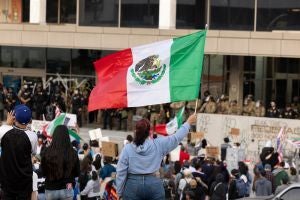
During large demonstrations, police may issue dispersal orders and arrest dozens of people at once. Peaceful protesters, journalists, legal observers, and bystanders can face criminal charges even if they were not involved in violent activity.
What Constitutes an Unlawful Assembly Under California Penal Code § 407?
Penal Code § 407 identifies two circumstances that can constitute unlawful assembly:
- Two or more people gathering with the intention of committing an unlawful act
- Two or more people gathering to perform a lawful act in a violent, boisterous, or tumultuous manner
However, California courts have substantially narrowed the second category to protect constitutional rights.
In In re Brown, 9 Cal.3d 612 (1973), the California Supreme Court ruled that an assembly organized for a lawful purpose cannot be treated as unlawful merely because participants are noisy or disruptive. The assembly must involve actual violence or present a clear and present danger of imminent violence.
For example, hundreds of demonstrators chanting outside a government building would not constitute an unlawful assembly simply because their messages are controversial or their voices disturb nearby businesses.
The circumstances change if participants begin attacking officers, assaulting other demonstrators, or threatening immediate violence. Such conduct may support an unlawful assembly determination, although individual criminal liability still depends on the specific charge.
Can Peaceful Protesters Be Convicted of Participating in an Unlawful Assembly?
Peaceful protesters cannot be convicted under Penal Code § 408 solely because they attended a demonstration where other people committed violent acts. This statute punishes individuals who knowingly and willfully participate in an unlawful assembly.
Under California's CALCRIM 2685 jury instructions, prosecutors must prove that:
- The defendant willfully participated in an unlawful assembly
- The defendant knew the assembly was unlawful when participating
- The gathering involved an agreement or purpose to commit a crime, or involved actual or imminently threatened violence while pursuing a lawful objective
These requirements become particularly relevant when a demonstration changes character.
Someone might attend a peaceful march that later deteriorates into violence after a separate group begins destroying property. Their earlier attendance does not establish knowing participation in the unlawful assembly.
However, someone who recognizes that the gathering has become violent and intentionally joins the unlawful activity may face prosecution under Penal Code § 408.
What Are the Penalties for Unlawful Assembly, Failure to Disperse, and Related Protest Offenses in California?
|
Offense / Legal Code |
Statutory Penalties & Consequences |
|
Unlawful Assembly (Penal Code § 408) |
Up to 6 months in county jail and fines up to $1,000. |
|
Failure to Disperse (Penal Code § 409 / § 416) |
Up to 6 months in county jail and fines up to $1,000. |
|
(Penal Code §§ 404 / 405) |
Up to 1 year in county jail and fines up to $1,000. |
|
(Penal Code § 404.6(a)) |
Up to 1 year in county jail and fines up to $1,000. |
|
Resisting / Obstructing an Officer (Penal Code § 148(a)(1)) |
Up to 1 year in county jail and fines up to $1,000. |
|
(Penal Code § 415) |
Up to 90 days in county jail and fines up to $400 (or fine-only infraction). |
Can Police Arrest Bystanders or Journalists During Mass Protest Sweeps?
Police may arrest individuals during mass demonstrations when they have a legal basis, but simply standing near protesters does not establish participation in an unlawful assembly.
This becomes particularly problematic during police containment operations, sometimes called kettling, when officers surround a large group and restrict their ability to leave.
People inside the perimeter may include:
- Journalists documenting police actions or interviewing demonstrators
- Legal observers monitoring arrests and potential civil rights violations
- Bystanders walking through the area before police establish a perimeter
- Peaceful protesters attempting to leave after violence erupts nearby
- Employees or residents caught between police lines and demonstrators
What Is the Difference Between Penal Code § 408 and Penal Code § 409?
Penal Code § 408 addresses knowing participation in an unlawful assembly, while Penal Code § 409 punishes willfully remaining at the scene of a riot, rout, or unlawful assembly after a lawful order to disperse.
Under Penal Code § 409, someone may face charges even if they never participated in the underlying violence. For example, a peaceful demonstrator who remains at the scene after receiving a lawful dispersal order may violate Penal Code § 409 despite having committed no violent act.
A valid prosecution depends on several circumstances:
- Whether the gathering legally qualified as a riot, rout, or unlawful assembly
- Whether an authorized public officer issued a lawful dispersal order
- Whether the warning was reasonably communicated so people could hear it
- Whether the defendant willfully remained after the order
California courts have recognized that officers need not use particular words when ordering dispersal. However, the command must reasonably communicate that people are required to leave.
A defendant who could not hear the warning because of distance, police sirens, or surrounding noise may have grounds to challenge the charge. Similarly, evidence that police blocked available exits can help establish that remaining at the scene was involuntary rather than a deliberate refusal.
Can Protesters Face Additional Charges?
Yes. Police may refer several offenses for prosecution following a confrontation at a demonstration. Each addresses different conduct.
- Penal Code §§ 404 and 405 - Participating in a Riot: Up to one year in county jail and a $1,000 fine
- Penal Code § 404.6(a) - Inciting a Riot: Up to one year in county jail and a $1,000 fine
- Penal Code § 148(a)(1) - Resisting or Obstructing an Officer: Up to one year in county jail and a $1,000 fine
- Penal Code § 408 - Participating in an Unlawful Assembly: Up to six months in county jail and a $1,000 fine
- Penal Code § 409 - Failure to Disperse: Up to six months in county jail and a $1,000 fine
- Penal Code § 416(a) - Refusal to Disperse: Up to six months in county jail and a $1,000 fine
Prosecutors may also consider charging disturbing the peace under Penal Code § 415, which is a misdemeanor carrying up to 90 days in county jail and may be treated as an infraction.
A Penal Code § 415 resolution can be an option in plea negotiations, although peaceful, First Amendment-protected conduct should not be treated as criminal simply to resolve an unlawful assembly prosecution.
How Can You Defend Against Penal Code § 407 Unlawful Assembly Charges?
Defending against unlawful assembly and failure to disperse charges requires showing your conduct was constitutionally protected, you lacked criminal intent, or police actions made compliance impossible. Key defense strategies include:
Lack of Intent or Knowledge
Under Penal Code § 408, prosecutors must prove you knowingly and willfully participated in an unlawful assembly. If you attended a peaceful demonstration that later turned violent without your knowledge or participation, your presence alone does not establish criminal intent or guilt.
Lack of Imminent Danger or Violence
Under California constitutional law (In re Brown), a gathering cannot be declared an unlawful assembly merely because participants are loud, boisterous, or disruptive. The defense can show that the demonstration remained peaceful and posed no actual or imminent threat of violence.
Inaudible or Defective Dispersal Orders
To convict someone of failure to disperse under Penal Code § 409, police must issue a clear and audible dispersal order. If traffic noise, sirens, distance, or inadequate sound equipment prevented you from hearing the order, you cannot be convicted of willfully disobeying it.
Inability to Disperse Due to Police Kettling or Blockades
If law enforcement officers establish containment perimeters (kettling) or block available exit routes, remaining at the scene is involuntary. Proving that police physical blockades prevented you from leaving refutes allegations of willful refusal to disperse.
First Amendment Protections and Media Observer Exemption
Peaceful political expression, news gathering by journalists, and monitoring by legal observers are protected activities under the First and Fourteenth Amendments. Demonstrating that you were lawfully present in a public forum and did not engage in unlawful acts provides a strong defense.
Hypothetical Case Study: Film Producer Avoids Criminal Conviction After Arrest at Los Angeles Demonstration
The Allegation
A prominent Los Angeles film producer attended a large-scale demonstration concerning ongoing conflict in the Middle East that drew thousands of participants and opposing activist groups to downtown Los Angeles.
Tensions escalated when rival factions confronted each other near a major intersection, resulting in property damage, thrown objects, and attempts to breach police barricades.
Before the violence, the producer helped organize the peaceful march and posted a social media update urging marchers to "hold the line" and keep opposing groups from blocking their permitted route.
When law enforcement declared an unlawful assembly under Penal Code § 407, officers established containment perimeters (kettling) around hundreds of demonstrators. The producer was arrested and charged with:
-
Participating in an Unlawful Assembly (Penal Code § 408)
-
Failure to Disperse (Penal Code § 409)
-
Resisting or Obstructing an Officer (Penal Code § 148(a)(1))
Police arrest reports asserted that the producer ignored repeated dispersal orders, encouraged violent confrontation via social media, and physically obstructed an officer attempting to clear the intersection.
The Prosecution's Case and Initial Challenges
State prosecutors built their case around digital communications, police body-camera recordings, and officer statements:
-
Public Messages as Evidence of Intent: Prosecutors argued the "hold the line" message constituted proof of inciting a confrontation and knowing participation in an unlawful assembly under PC § 408.
-
Presence After Dispersal Orders: Body-camera footage confirmed the producer remained in the intersection after dispersal commands were issued, supporting the PC § 409 charge.
-
Physical Contact with Law Enforcement: Video recordings showed the producer making physical contact with an officer's arm near a police barricade, supporting the PC § 148(a)(1) obstruction charge.
The Defense Strategy
Our defense team at Eisner Gorin LLP launched a comprehensive investigation, synchronizing police radio traffic, body-camera footage, independent livestream recordings, and private organizational messages:
-
Contextualizing Social Media Messages: We retrieved complete message threads between organizers showing that "hold the line" referred strictly to maintaining the pre-permitted march route away from traffic hazards. Further messages proved the producer explicitly instructed volunteer safety marshals to direct participants away from hostile counter-protesters.
-
Proving Involuntary Presence (Police Kettling): Multi-angle video synchronized with police audio established that while a dispersal order was given, law enforcement simultaneously established containment lines. Footage proved the producer made two separate attempts to leave via adjacent side streets, but officers blocked both exit routes, rendering compliance with the dispersal order physically impossible.
-
Rebutting Physical Obstruction Charges: Frame-by-frame analysis of body-camera footage demonstrated that the physical contact occurred when police shoved a crowd backward toward a barricade. Witness statements confirmed the producer briefly touched the officer's arm solely to prevent himself from falling to the ground, rather than to resist or obstruct law enforcement.
The Judicial Outcome
After reviewing our synchronized video evidence, communications analysis, and physical exit recordings, prosecutors dismissed both the Penal Code § 408 (Unlawful Assembly) and Penal Code § 409 (Failure to Disperse) counts.
Regarding the remaining misdemeanor Penal Code § 148(a)(1) count, our defense attorneys demonstrated that the physical contact was incidental to the police crowd-control movement while the producer was attempting to navigate toward an established exit point.
Following negotiations, prosecutors agreed to dismiss the remaining obstruction count in exchange for the producer completing a brief community service program. The producer avoided a criminal conviction and record, allowing him to maintain his professional commitments and public reputation without a trial.
Frequently Asked Questions (FAQs)
Reviewing these common legal questions helps peaceful protesters, legal observers, journalists, and bystanders understand their First Amendment rights, constitutional protections, and statutory defenses when facing California assembly charges.
What legal threshold must police meet to declare an assembly unlawful in California?
Under California Supreme Court precedent (In re Brown), law enforcement cannot declare a gathering unlawful merely because participants are loud, boisterous, or disruptive; the assembly must involve actual violence or present a clear, imminent threat of violence.
Can I be convicted under Penal Code § 408 if I stayed peaceful while others turned violent?
No, a conviction for participating in an unlawful assembly under Penal Code § 408 requires prosecutors to prove beyond a reasonable doubt that you willfully participated in the gathering with knowledge of its unlawful purpose or violent intent.
What should I do if I am caught in a police "kettling" perimeter and cannot leave?
If police physically block exits or establish containment lines preventing your departure, remaining at the scene is considered involuntary, which refutes allegations that you willfully failed or refused to disperse under Penal Code §§ 409 or 416.
Are journalists and legal observers exempt from protest dispersal orders in California?
Under California Penal Code § 409.7 (Senate Bill 98), duly authorized journalists and news representatives have explicit legal protections allowing them to enter and remain in closed areas or command perimeters during protests to cover First Amendment activities without facing failure to disperse charges.
How do prosecutors prove I heard a police dispersal order?
Prosecutors must establish that the dispersal order was communicated reasonably and audibly; if ambient crowd noise, police sirens, distance, or inadequate sound amplification prevented you from hearing the command, you lack the required willful intent to disobey.
What is the difference between Penal Code § 409 and Penal Code § 416?
Penal Code § 409 punishes remaining present at an unlawful assembly after a lawful order to disperse, regardless of your personal actions, while Penal Code § 416 targets individuals who assemble with the intent to commit an unlawful act or disturb the peace and refuse to disperse.
Contact a California Defense Lawyer for Help
When a peaceful demonstration, press coverage, or legal observation results in an arrest under Penal Code § 407, § 408, or § 409, early legal intervention is critical.
Mass arrests during protests often involve blanket charges, where innocent bystanders, journalists, and peaceful protesters are swept up alongside individuals engaging in violent or unlawful conduct.
Our defense team at Eisner Gorin LLP specializes in protecting First Amendment rights and defending clients facing misdemeanor and felony protest-related allegations across Southern California.
We independently review police body-camera footage, examine livestream recordings, audit law enforcement communications, and present contextual evidence to district attorneys and city prosecutors to secure pre-trial dismissals or charge reductions.
If you or a loved one were arrested during a demonstration or face failure-to-disperse charges, contact our Los Angeles office today to schedule a confidential case evaluation with an experienced defense attorney.

 If you have one phone call from jail, call us! If you are facing criminal charges,