
Protests often evoke passionate and sometimes chaotic situations, particularly in densely populated areas like Los Angeles. Protests often spill into the streets, blocking traffic, and the interaction between drivers and protesters occasionally results in injury, sometimes unintentionally and sometimes intentionally.
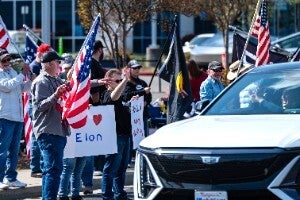
With recent protests sweeping the state, such as those witnessed in the L.A. area, tensions between drivers and demonstrators have occasionally escalated, raising the question: Can a driver be arrested and/or charged with a crime for hitting a protester?
The short answer is yes, depending on the circumstances and intent, drivers have been known to face criminal charges for striking protesters.
Such was the case in Riverside, where a driver was charged with assault with a deadly weapon after hitting a protester with their vehicle during the "No Kings" rally in June.
If convicted, a driver could face significant fines and prison time, depending on the driver's intent, the circumstances, and the extent of the victim's injuries.
Various California crimes may be charged for striking a protester with a vehicle. California law affords prosecutors an array of avenues to charge drivers with crimes after hitting protesters. Let's look briefly at some of the more common charges that may result.
Assault with a Deadly Weapon (Penal Code § 245(a)(1) PC)
If a driver intentionally uses their vehicle to strike or even attempt to strike a protester, they could be charged with assault with a deadly weapon. Under California law, a car is classified as a deadly weapon when used in this manner.
This charge applies even if contact with the protester does not result in serious injury. Those convicted of this felony could face up to four years in prison, and the penalties increase if the act causes significant bodily harm.
PC 245(a)(1) says, "(a) (1) Any person who commits an assault upon the person of another with a deadly weapon or instrument other than a firearm shall be punished by imprisonment in the state prison for two, three, or four years, or in a county jail for not exceeding one year, or by a fine not exceeding ten thousand dollars ($10,000), or by both the fine and imprisonment."
Attempted Murder (Penal Code §§ 664/187)
Drivers accused of deliberately using their vehicle to harm or kill someone may face attempted murder charges. This charge requires prosecutors to prove specific intent to kill, which could be inferred from actions such as accelerating toward a crowd or targeting individuals.
If convicted, penalties include life imprisonment with the possibility of parole, making it one of the most severe charges a driver could face in these scenarios.
PC 664 says, "Every person who attempts to commit any crime, but fails, or is prevented or intercepted in its perpetration, shall be punished where no provision is made by law for the punishment of those attempts."
Attempted Voluntary Manslaughter (Penal Code §§ 664/192(a))
This charge may apply when a driver acts in the heat of passion or under the influence of provocation. For instance, if a driver surrounded by protestors panics, speeds up, and injures someone, prosecutors might argue that their actions lacked malice but were still unlawful.
Conviction of felony voluntary manslaughter can result in a prison term of up to five years.
PC 192(a) says, Manslaughter is the unlawful killing of a human being without malice. It is of three kinds: (a) Voluntary-upon a sudden quarrel or heat of passion."
Battery Causing Serious Bodily Injury (Penal Code § 243(d))
Aggravated battery charges apply when a driver uses willful force that causes significant physical injury to a protester, even if there was no intent to kill. The charge can be classified as a felony or misdemeanor, with penalties for felonies including up to four years in prison.
This offense underscores that serious harm, even if unintended, carries heavy legal consequences.
PC 243(d) says, "When a battery is committed against any person and serious bodily injury is inflicted on the person, the battery is punishable by imprisonment in a county jail not exceeding one year or imprisonment pursuant to subdivision (h) of Section 1170 for two, three, or four years."
Reckless Driving Causing Injury (Vehicle Code § 23104)
Reckless driving charges may be filed when prosecutors are less certain about proving willful intent but can show that the driver demonstrated disregard for safety with their vehicle, resulting in injury.

This could include situations where a driver enters a crowd of protestors at high speed without necessarily intending harm. If injuries are minimal, this offense may be classified as a misdemeanor, carrying a penalty of up to six months in jail.
However, more severe injuries could significantly elevate the penalties.
VC 23104 says, "(a) Except as provided in subdivision (b), whenever reckless driving of a vehicle proximately causes bodily injury to a person other than the driver, the person driving the vehicle shall, upon conviction thereof, be punished by imprisonment in the county jail for not less than 30 days nor more than six months or by a fine of not less than two hundred twenty dollars ($220) nor more than one thousand dollars ($1,000), or by both the fine and imprisonment."
Hit and Run (Vehicle Code § 20001)
Failing to stop after hitting a protester can lead to hit-and-run charges. California law requires drivers involved in accidents causing injury or fatality to stop, provide information, and render aid.
Fleeing the scene is a criminal offense punishable by up to four years in prison and substantial fines. Courts also view leaving the scene as a sign of culpability, which can harm a driver's defense.
VC 20001 says, "(a) The driver of a vehicle involved in an accident resulting in injury to a person, other than himself or herself, or in the death of a person shall immediately stop the vehicle at the scene of the accident and shall fulfill the requirements of Sections 20003 and 20004."
Vehicular Manslaughter (Penal Code § 192(c))
If a protester dies as a result of being struck, and the driver acted with negligence (but without intent to kill), vehicular manslaughter charges may follow.

Gross negligence may result in up to six years in prison, while ordinary negligence may lead to a misdemeanor charge, carrying a maximum penalty of up to one year of imprisonment. These charges underline the gravity of causing fatal harm, even unintentionally.
PC 192(c) says, "Vehicular. (1) Except as provided in subdivision (a) of Section 191.5, driving a vehicle in the commission of an unlawful act, not amounting to a felony, and with gross negligence; or driving a vehicle in the commission of a lawful act which might produce death, in an unlawful manner, and with gross negligence.
(2) Driving a vehicle in the commission of an unlawful act, not amounting to a felony, but without gross negligence; or driving a vehicle in the commission of a lawful act which might produce death, in an unlawful manner, but without gross negligence.
(3) Driving a vehicle in connection with a violation of paragraph (3) of subdivision (a) of Section 550, where the vehicular collision or vehicular accident was knowingly caused for financial gain and proximately resulted in the death of any person. This paragraph does not prevent the prosecution of a defendant for the crime of murder."
Hate Crime Enhancements (Penal Code §§ 422.55, 422.75)
If evidence suggests that a driver targeted protestors based on their race, religion, or political beliefs, hate crime enhancements may be added to the underlying charges. These enhancements increase the severity of penalties and reflect the state's stance against crimes motivated by prejudice or bias.
PC 422.55 says, "(a) 'Hate crime' means a criminal act committed, in whole or in part, because of one or more of the following actual or perceived characteristics of the victim: (1) Disability. (2) Gender. (3) Nationality. (4) Race or ethnicity. (5) Religion. (6) Sexual orientation. (7) Association with a person or group with one or more of these actual or perceived characteristics."
Defending Against Charges Involving Hitting a Protestor
While the above charges cover a range of potential scenarios, driver intent plays a critical role in how these cases are prosecuted. For example, proving attempted murder requires evidence of deliberate intent to kill, while reckless driving hinges on demonstrating disregard for safety.
A skilled California criminal defense attorney can meticulously dissect the facts of a case, challenge the prosecution's interpretation of intent, and present mitigating circumstances to minimize the risks of conviction and severe penalties to the driver.
For more information, contact our criminal defense law firm, Eisner Gorin LLP, located in Los Angeles, CA.
Related Content:

 If you have one phone call from jail, call us! If you are facing criminal charges,